Vancouver offers one of North America’s most accessible and meaningful opportunities to connect with living Indigenous culture, where Coast Salish peoples have stewarded these lands for over 10,000 years. The best way to experience First Nations heritage here is through a combination of guided tours led by Indigenous storytellers, visits to cultural centers and authentic art galleries, and participation in traditional activities like canoe journeys or cedar weaving workshops.
What makes Vancouver unique is that you’re not visiting historical recreations. You’re stepping into the traditional territories of the Musqueam, Squamish, and Tsleil-Waututh Nations, communities that remain vibrant and active in shaping the city today. I still remember my first time hearing a welcome song at the Squamish Lil’wat Cultural Centre in Whistler. The power in those voices, the way the drummer’s rhythm seemed to sync with my heartbeat, it shifted something fundamental in how I understood this place I call home.
The truth is, most of us who live in or visit Vancouver walk through Indigenous spaces every day without realizing it. Stanley Park’s forest trails follow ancient pathways. English Bay was a seasonal village site. These aren’t abstract historical facts but part of the cultural narratives that continue to shape this region.
This guide will help you engage respectfully and authentically with First Nations experiences throughout Metro Vancouver, from museum exhibits and artist-led tours to hands-on workshops and ceremonial events. You’ll learn where to go, what to expect, and most importantly, how to approach these experiences with the curiosity and humility they deserve. Understanding comes from showing up and listening.
The Land Before Vancouver: Whose Territory Are You Standing On?
Long before the glass towers reflected in Coal Harbour, before Stanley Park received its colonial name, and before a single European ship anchored offshore, this land sustained thriving communities for over 10,000 years. What we call Metro Vancouver sits on the unceded traditional territories of three Coast Salish Nations: the xʷməθkʷəy̓əm (Musqueam), Sḵwx̱wú7mesh (Squamish), and səlilwətaɬ (Tsleil-Waututh). These aren’t just names on a land acknowledgment, they’re living nations with distinct languages, governance systems, and unbroken connections to this place.
The Musqueam people’s territory spans from the Fraser River delta across Point Grey. The Squamish Nation’s lands stretch from North Vancouver through Squamish and into Whistler. The Tsleil-Waututh, whose name translates to “People of the Inlet,” have stewarded Burrard Inlet and its watersheds. These territories overlap in places, reflecting thousands of years of intermarriage, trade, and shared resource management.
Life before contact was sophisticated and abundant. Massive cedar longhouses, some stretching 200 feet, housed extended families in permanent villages along river mouths and shorelines. The Fraser River teemed with salmon runs so thick you could supposedly walk across their backs, a resource managed through intricate fishing weirs, reef nets, and seasonal protocols that sustained populations without depleting stocks. Cedar provided everything from seagoing canoes to clothing, tools, and ceremonial masks. Women wove mountain goat wool and dog hair into blankets that became currency in elaborate trade networks reaching from California to Alaska.
This wasn’t wilderness waiting to be civilized. It was homeland, managed through Indigenous stewardship since time immemorial with controlled burns that promoted camas meadows and berry patches, clam gardens that increased shellfish yields, and spiritual practices tied to every mountain, creek, and stone. Potlatches redistributed wealth and affirmed family ties. Hereditary chiefs maintained governance structures. Oral histories, passed down through winter ceremonies, encoded everything from property rights to navigation routes.
When Captain George Vancouver arrived in 1792, he wasn’t discovering empty land. He was meeting nations with complex social hierarchies, legal systems, artistic traditions, and economies that had flourished here longer than European civilization had existed. Understanding that changes how you see every street corner in this city.
Places Where the Stories Still Speak
Museum of Anthropology at UBC
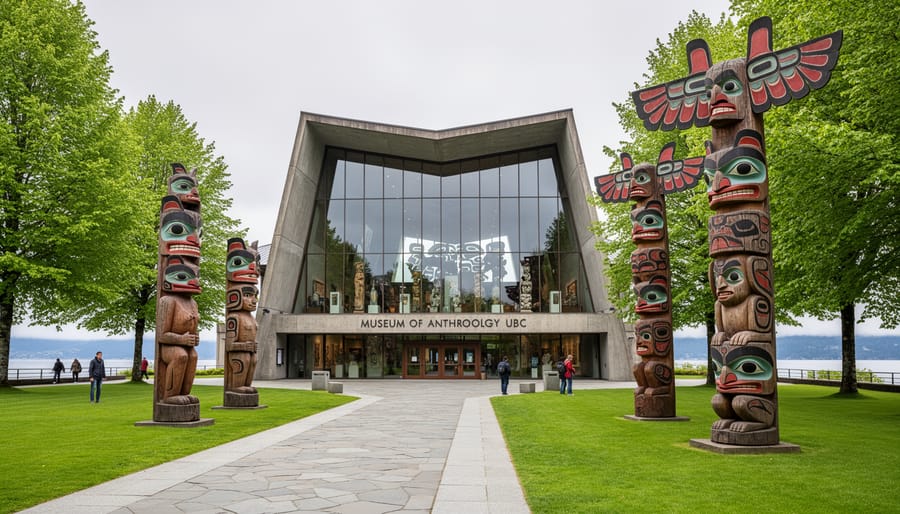
The Museum of Anthropology sits on a clifftop overlooking the ocean at UBC, and walking into the Great Hall feels like stepping into a cathedral of Northwest Coast art. Floor-to-ceiling windows frame two-story totem poles against a backdrop of mountains and sea, exactly as these monumental carvings were meant to be experienced, connected to the land and sky.
Start with the central collection that made MOA famous. Bill Reid’s The Raven and the First Men commands the rotunda, a massive yellow cedar carving depicting the Haida creation story, where Raven coaxes the first humans from a clamshell. Stand close enough and you’ll see individual tool marks, each deliberate cut revealing Reid’s decades of mastery. The sculpture tells you more about transformation, trickery, and emergence than any textbook chapter could.
The visible storage galleries revolutionized how museums display Indigenous artifacts. Rather than selecting a few “important” pieces for glass cases, MOA shows thousands of objects, bentwood boxes, feast dishes, ceremonial regalia, fishing tools, all accessible behind glass walls. You’re seeing how communities actually lived, not just what curators deemed exhibition-worthy.
Here’s what locals know: visit on Tuesday evenings when admission drops to five dollars, or come during the quieter weekday mornings when you can spend unrushed time with individual pieces. The Multiversity Galleries, added in recent years, feature rotating exhibitions often curated by Indigenous artists and knowledge keepers themselves.
Don’t skip the outdoor sculptures behind the building. Haida houses and mortuary poles stand among the trees, weathering naturally as their creators intended, slowly returning to the earth that gave them life.
Squamish Lil’wat Cultural Centre in Whistler
About two hours north of Vancouver, tucked into the forest between Whistler Village and Blackcomb Mountain, sits one of Canada’s most striking cultural institutions. The Squamish Lil’wat Cultural Centre tells the stories of two Nations who’ve shared these alpine territories for millennia, each maintaining distinct languages, customs, and connections to the land.
The building itself makes a statement before you even step inside. Designed through collaboration between Indigenous and non-Indigenous architects, it blends traditional longhouse and Istken (earthen pit house) elements with contemporary sustainability features. Natural light floods through massive timber beams and glass walls that frame views of the surrounding peaks, mountains that feature prominently in both Nations’ stories.
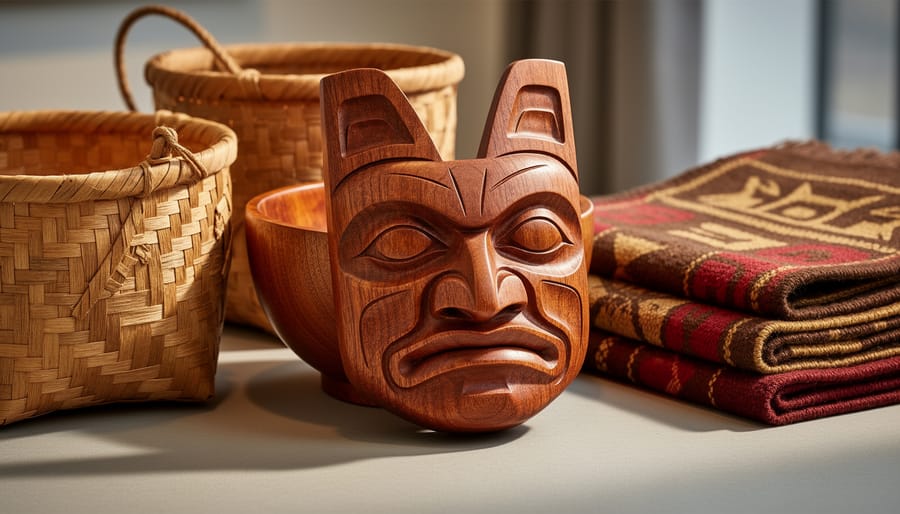
Inside, you’ll find separate galleries dedicated to each Nation’s artifacts, art, and history. The Squamish section showcases intricate basket weaving and explains the significance of cedar in virtually every aspect of traditional life. The Lil’wat exhibits include beautifully preserved clothing and tools that adapted to harsh alpine winters. Don’t rush through, each display case contains objects that represent centuries of inherited knowledge.
The guided tours, led by Squamish and Lil’wat ambassadors, transform these static exhibits into living narratives. I’ve watched guides demonstrate traditional games, explain the sophisticated engineering behind bentwood boxes, and share stories passed down through generations. They’ll answer questions about everything from traditional governance structures to contemporary challenges facing their communities.
The centre also hosts regular demonstrations, watch artists carve masks, weave baskets, or prepare traditional foods in the Great Hall. If you’re visiting Whistler for skiing or mountain biking, dedicate at least two hours here. It completely reframes those mountains from recreational playground to ancestral homeland.
Indigenous Art and Monuments Throughout the City
Vancouver’s outdoor playground doubles as an open-air gallery of First Nations art, where centuries-old carving traditions meet contemporary Indigenous voices. You don’t need a museum ticket to encounter some of the most powerful storytelling in the city.
Stanley Park holds the most concentrated collection, with nine totem poles standing at Brockton Point. Contrary to what many assume, these aren’t ancient artifacts but were gathered from different coastal communities in the 1920s and later, with some replacements carved as originals weathered. Each tells distinct family or clan stories through figures like Thunderbird, Raven, and Bear.
| Location | Artwork | Artist/Nation | Significance |
|---|---|---|---|
| Stanley Park (Brockton Point) | Totem Pole Collection | Various Nations | Historic poles representing different coastal communities |
| Vancouver International Airport | The Spirit of Haida Gwaii | Bill Reid (Haida) | Bronze cast of Reid’s iconic jade canoe sculpture |
| English Bay | A-maze-ing Laughter | Yue Minjun | 14 bronze laughing figures (not Indigenous but beloved landmark) |
| Musqueam Community | c̓əsnaʔəm | Susan Point (Musqueam) | House post honoring 4,000-year-old village site |
| Vancouver Convention Centre | Digital Orca | Douglas Coupland | Pixelated killer whale referencing Haida art |
The airport’s Spirit of Haida Gwaii greets international arrivals with Bill Reid’s vision of mythological beings paddling together in a canoe, an appropriate metaphor for a diverse city. Meanwhile, Susan Point’s sleek stainless steel works throughout the city, including pieces near nearby parks show how traditional Coast Salish design translates into contemporary public art that commands attention in modern urban spaces.
Experiences That Transform Understanding
Guided Walking Tours with Indigenous Leaders
I’ll never forget the moment our guide, a Squamish Nation elder, stopped our group at a nondescript parking lot near Kitsilano Beach and said, “This is where my grandfather’s longhouse stood.” Suddenly, the concrete and cars dissolved in my mind, replaced by an image of cedar-planked homes, canoes pulled onto shore, and families gathering for salmon runs. That’s the power of walking Vancouver with someone whose family has called this land home for millennia.
Talaysay Tours leads the pack in Indigenous-led experiences, offering walks that completely transform how you see the city. Their “Lost Souls of Gastown” tour reveals the Indigenous history beneath Vancouver’s oldest neighbourhood, while their Stanley Park walk explains how the park displaced thriving Squamish villages. The guides don’t just recite dates; they share personal stories, explain place names in their ancestral languages, and point out plants their grandmothers taught them to harvest.
Beyond Talaysay, several Nations offer their own guided experiences. The Squamish Nation runs tours of their cultural center and traditional territory in North Vancouver. During salmon spawning season, some tours include visits to active fishing sites where guides demonstrate traditional harvesting methods their families have used for generations.
These aren’t your typical tourism walks. You might stand at English Bay while your guide describes ancient reef net fishing techniques, or pause beneath towering Douglas firs as someone explains how their ancestors used every part of these trees. The buildings and beaches become layered with meaning you’d never discover on your own.
Book directly through Indigenous operators when possible. Tours typically run two to three hours and cost between forty and eighty dollars. They fill quickly during summer, so reserve ahead.
Culinary Journeys and Traditional Foods
Walking into Salmon n’ Bannock on East Broadway feels like stepping into someone’s kitchen, if that someone happens to be serving up 10,000 years of culinary tradition. This Indigenous-owned restaurant doesn’t just feed you; it educates you through every bite.
The menu reads like a geography lesson in Coast Salish territory. Wild salmon prepared using traditional methods sits alongside bison, venison, and bannock (the fry bread that’s become a staple across Indigenous communities). What strikes you isn’t just the flavour, it’s realizing these ingredients sustained thriving societies for millennia before grocery stores existed.
Inez Cook, one of the restaurant’s founders, deliberately designed the space to spark conversations about food sovereignty and cultural preservation. The Three Sisters (corn, beans, squash) appear in various dishes, demonstrating the agricultural knowledge that European narratives often erased. Berries feature prominently too, not as garnish, but as historically significant foods that were dried, traded, and celebrated.
Beyond Salmon n’ Bannock, you’ll find Indigenous food vendors at festivals and markets throughout Vancouver. The Lelem’ Arts Café at the Squamish Nation serves contemporary Indigenous cuisine with traditional roots. Even mainstream restaurants increasingly acknowledge they’re cooking on unceded territory while incorporating Indigenous ingredients with proper attribution.
Food becomes a powerful teacher when you understand its cultural context, every traditional dish carries stories of season, ceremony, and survival.
Cultural Performances and Events
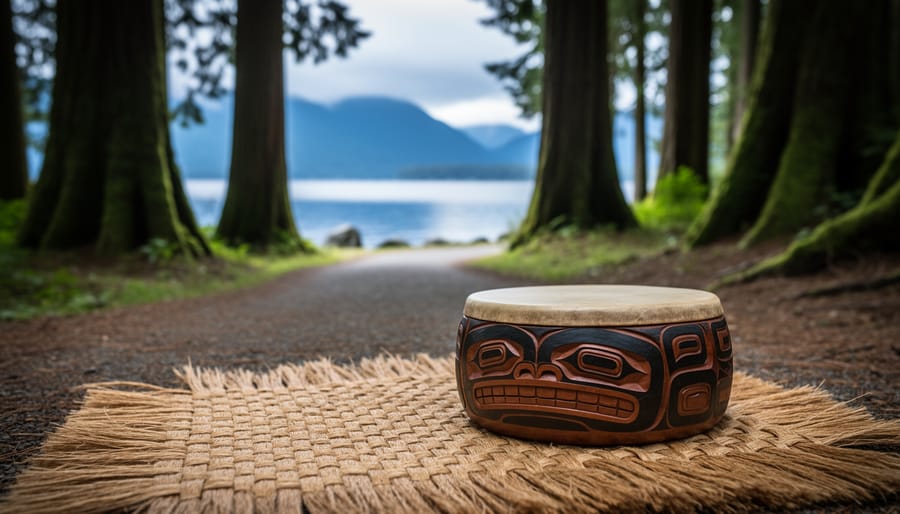
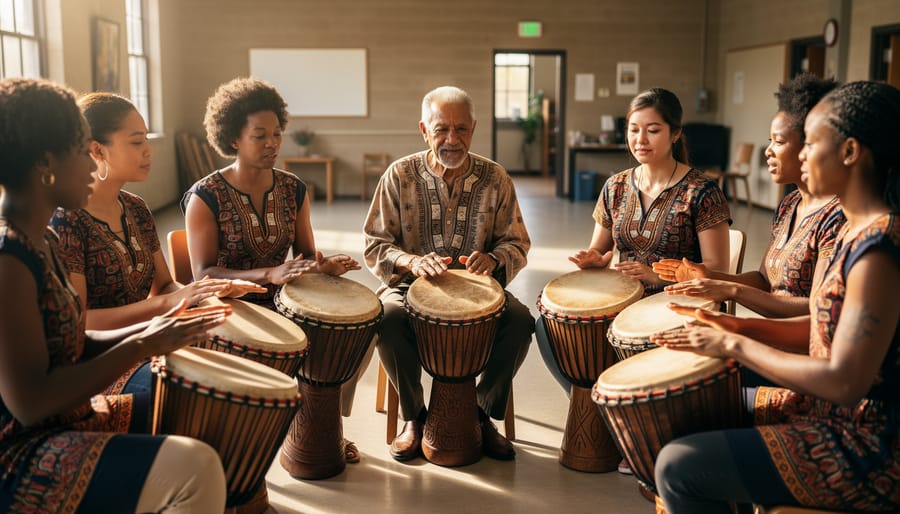
Throughout the year, Metro Vancouver pulses with Indigenous performances that transform abstract history into visceral, emotional experience. The beating of a drum during a Coast Salish welcome ceremony creates a physical sensation you’ll feel in your chest, a rhythm that has opened gatherings for millennia.
The Talking Stick Festival, held each February, is Western Canada’s largest gathering of Indigenous performing arts. Expect contemporary Indigenous plays, dance pieces that fuse traditional and modern movement, and storytelling that will make you laugh and cry, often within minutes. It’s nothing like the static, museum-piece performances some visitors expect.
Summer brings free cultural demonstrations to Waterfront Station and various community centers, where you might catch master carvers at work or children learning ancestral dances. The Squamish Nation Powwow, typically held in July, welcomes visitors to witness competitive dancing, intricate regalia, and intertribal celebrations. Arrive early, dress respectfully, and remember you’re a guest, ask before photographing dancers, and never touch regalia or drums without permission.
Many cultural centers offer smaller, intimate storytelling circles year-round, where elders share creation stories and teaching tales that have educated generations.
What They Didn’t Teach Us: The Difficult Chapters
The story of First Nations in Vancouver isn’t complete without confronting what happened after European contact, and it’s a chapter most of us never got in school.
In 1876, the Indian Act became law, creating a system of control that stripped Indigenous peoples of their rights, lands, and children. Between the 1880s and 1996, over 150,000 Indigenous children across Canada were forcibly removed from their families and placed in residential schools designed to “kill the Indian in the child.” In BC alone, 18 of these institutions operated, including one on the Squamish Mission reserve from 1898 to 1959.
The impacts weren’t abstract. Children were punished for speaking their languages, practising their traditions, or even acknowledging their families. Thousands suffered abuse. Many never came home. The intergenerational trauma from this system, combined with the ongoing effects of land displacement, poverty, and systemic discrimination, shapes Indigenous communities today.
Local First Nations also lost massive portions of their territories. The Musqueam, Squamish, and Tsleil-Waututh once held vast lands that are now Vancouver’s most valuable real estate. Much was taken without treaties or consent. Stanley Park, for instance, was cleared of its Squamish and Tsleil-Waututh residents in the 1920s, their homes burned to make way for a “natural” park tourists enjoy today.
Why does this matter now? Because reconciliation isn’t possible without truth. When visitors come to Vancouver for Canada Day plans or casual sightseeing, they’re walking on stolen land with a history most Canadians weren’t taught. Understanding this context transforms how you see the city.
BC has started changing how these stories are told. Since 2016, Indigenous content has been woven throughout the provincial curriculum rather than relegated to a single unit. Universities now require Indigenous-focused courses. Museums are rewriting their narratives with Indigenous voices leading.
This isn’t about guilt, it’s about informed respect and being honest about the place you’re visiting.
How Vancouver Is Changing the Conversation
Vancouver’s education system has undergone a profound transformation in how it teaches Indigenous history and culture. Walk into a BC classroom today and you’ll find a dramatically different curriculum than what previous generations experienced. Since the province mandated Indigenous content across all grade levels, students now learn about xʷməθkʷəy̓əm, Sḵwx̱wú7mesh, and səlilwətaɬ perspectives starting in kindergarten, not as a tokenistic sidebar but woven throughout subjects from science to literature.
The University of British Columbia and Simon Fraser University have expanded their Indigenous studies programs significantly, offering everything from certificate courses to full degree programs developed in partnership with local Nations. UBC’s First Nations House of Learning now serves over 2,000 Indigenous students annually, while SFU’s Indigenous Student Centre provides cultural resources and academic support that recognize the unique needs of First Nations learners.
Beyond schools, Vancouver’s institutions are backing words with action. The city requires all staff to complete Indigenous cultural competency training. Museums have begun returning artifacts to their rightful Nations, recognizing that some sacred objects were never meant for display cases. The Vancouver Public Library system now features dedicated Indigenous collections curated with input from Elders.
Perhaps most significantly, local First Nations are reclaiming their role as knowledge keepers on their own terms. The Musqueam Indian Band now offers its own educational programs directly to schools and organizations, cutting out the intermediary interpretations that once filtered their stories. Squamish Nation has developed curriculum materials that schools across the region use, ensuring their history gets told accurately.
These aren’t token gestures. They represent a fundamental shift in who controls the narrative about First Nations history and who benefits from sharing that knowledge.
Engaging Respectfully: What Visitors Should Know
Walking into any First Nations cultural space or experience requires more awareness than booking a regular tourist attraction. I learned this the hard way during my first visit to a cultural event years ago, when I enthusiastically snapped photos without asking and later felt mortified learning certain ceremonies weren’t meant to be photographed. The good news? Most cultural centers and guides understand that visitors are learning, and they appreciate genuine curiosity paired with respect.
Before engaging with First Nations experiences, understanding some basic concepts helps tremendously:
- Reconciliation
- The ongoing process of acknowledging historical wrongs against Indigenous peoples and working together to build respectful, equitable relationships moving forward.
- Territorial Acknowledgment
- A practice of recognizing the Indigenous peoples whose traditional, ancestral, and unceded territories you’re on, showing respect for their ongoing connection to the land.
- Cultural Appropriation
- Taking or using elements of Indigenous culture without permission, understanding, or respect, distinct from cultural appreciation, which involves learning with humility and proper context.
- Protocols
- Specific cultural practices and rules that govern respectful behavior in Indigenous spaces, which vary between Nations and contexts.
When visiting cultural sites, always ask before photographing people, ceremonies, or sacred objects. Many spaces have clear signage about what’s permitted, but when in doubt, ask a guide or staff member. Listen more than you speak, especially during storytelling or educational components. Avoid touching artifacts, art, or ceremonial items unless explicitly invited to do so.
Language matters significantly. Use the proper names of Nations rather than generic terms when possible, say Squamish or Musqueam rather than defaulting to “native” or outdated terms. If you’re unsure how to pronounce a word, asking respectfully shows more consideration than avoiding it entirely.
Approach these experiences as a student, not a consumer. You’re being invited into someone’s living culture, not viewing a museum exhibit frozen in time. Ask thoughtful questions, but recognize that some knowledge is sacred or private, not meant for sharing with outsiders. Indigenous guides aren’t obligated to educate you about every aspect of their culture or answer personal questions about their identity.
Understanding First Nations history transforms how you see Vancouver. That stunning waterfront? It’s been a gathering place for millennia. The mountains framing your Instagram shots? Sacred landmarks with names and stories that predate English by thousands of years. Every neighbourhood, park, and street corner sits on land shaped by Indigenous stewardship and survival.
This isn’t academic history locked in textbooks. It’s living culture woven into the city’s present and future. When you visit the Museum of Anthropology or join a Talaysay Tour, you’re not checking off a tourist box, you’re beginning a conversation that matters. You’re learning to see this place through the eyes of its original inhabitants and their descendants who continue to thrive here.
The good news? Vancouver offers more opportunities than ever to engage authentically. Start with one experience that calls to you. Listen more than you speak. Ask questions with genuine curiosity. Then keep going. Read books by Indigenous authors. Support Indigenous-owned businesses. Follow local Nations on social media.
Real understanding doesn’t happen in an afternoon, but every step forward matters.